As an undergraduate student at the University of Toronto studying Employment Relations, we learned about the New Employment Model: a theory that employment had evolved in the one hundred and fifty years since the Industrial Revolution.
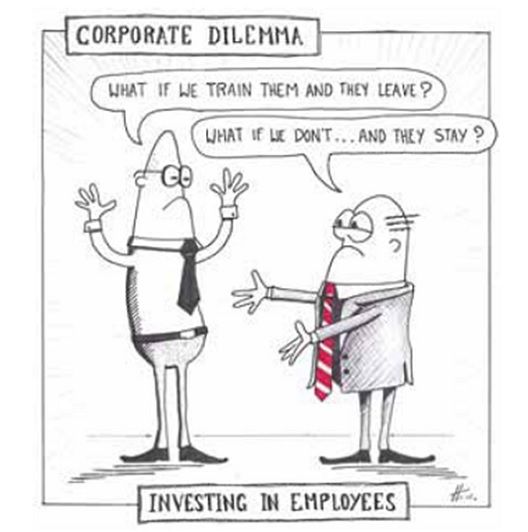
The theory proposed that while in the old, industrial model employees would serve for a lifetime at one company, the new employment model is made of short service spans at many companies. The model argued that since employees wanted to switch jobs many times in their career, organizations shouldn’t fight it — after all, they benefited from talent coming onto the team from other organizations.
The result is the now-ubiquitous adage embodied in this cartoon.
But where does the path of this new employment model lead? Is the model itself even “new”, or an evolution of the original employment model? And, presuming that employment is evolving with technological changes, what does the future look like for companies and their employees?
From skill development to skill shifting
In the current, “new” employment model, organizations train their people based on the roles that they have. A software engineer is trained to become a better software engineer. An accountant is trained on new accounting practices. A policy advisor attends a conference with other policy advisors to learn from them.
What it means to be an accountant, a software engineer, or a policy advisor will evolve with increasing frequency.
As automation and technology continue to disrupt, the need for skill development will change to skill shifting. No longer will it be sufficient to “stay in our lane,” organizations will instead be focused on specific skill development and shifting our skills to critical areas. No longer will an end to education in our twenties be sufficient, employees will increasingly need to become life-long learners. Companies will be a major source of that learning — inside and outside of the current role. What it means to be an accountant, a software engineer, or a policy advisor will evolve with increasing frequency.
Already this practice is growing and occurring. The reason? Technology is disrupting the way we work in new and profound manner. Machine learning and automation promise to make many tasks redundant; meaning employees will need to transition from those tasks to new ones. So while we might remain a Business Analyst, what that means in terms of skills will constantly evolve and shift depending on the technology implemented.
From shared space to distributed space
With the COVID-19 pandemic up-ending regular workspaces, the shift to a distributed workforce not sharing a central location has received plenty of spotlight. Zoom, Slack, Trello, and countless other platforms have become household names around the globe. So, the future of distributed spaces seems closer than ever.
Yet, it’s important to consider the impacts that distributed work has on employees and the employment model. What does it mean for us — the employee — when every company is remote and virtual? What does it mean for the company?
For one, it will exacerbate the new employment model’s theory of shifting loyalties. Never co-locating means the ties holding an employee to a certain job — comfort, friends, commutes — are easily transferable. Comfort is in your home office and will follow you between jobs. Friends have more ways to keep in touch than ever before. Commutes are never shorter than a remote work environment.
It also means greater free-time to spend on other pursuits, and — crucially — skills or learning. The hours spent on a train or bus can now be leveraged to learn new things. And while for many it will be hobbies, for some it may be employable skills to add to their repertoire.
From accreditations to showcases
As skills and tasks evolve and shift with increasing frequency, static accreditations will become worryingly out-of-date. This is a growing trend already seen in workplaces around the globe. A MBA received in 2005 is quite different than a MBA in 2020, and the gap will continue to widen over smaller timeframes.
It is not a far-fetched prediction to see the 20th century’s paper resume ending its reign.
The ability to showcase skills, however, will remain critical. With the growth of online portfolio platforms, it is becoming easier and easier to share our knowledge and abilities with open audiences. Employers increasingly view projects and portfolios as valid methods of demonstrating experience, not to mention gamified competition communities like Kaggle. It is not a far fetched prediction to see the 20th century’s paper resume ending its reign.
Employees will increasingly want to be part of projects that add to their skills or validate their abilities. Companies will service those projects with increasing openness and flexibility.
From closed doors to open networks
The scale and flexibility of future-oriented companies requires that they begin to open what were previously limited boundaries. No longer limited to staffs, but companies also engaging networks of collaborators who can assist with projects — the same projects they, in turn, can showcase. This rise can already be witnessed on a number of “gig economy” platforms featuring professionals plying their craft.
Given the benefits to companies — cheaper, more flexible labour — this isn’t a practice likely to subside. And it does offer some benefit to the individuals involved, increasing their showcases. However, there are plenty of challenges on the horizon, including regulatory involvement on the definition of employee to protect vulnerable “gig economy” participants.
Where are we heading?
It’s a fool’s guess to predict the future, but the trend of the late 20th and 21st century seems poised to continue. Increasing turnover, more independent employees, and lifelong learning are already staples of today’s employment model. The future promises to continue those trends, and increase the speed of evolution of work. The next employment model may only last a decade (or less) before becoming archaic itself, but it may be defined by reskilling employees, distributed workforces, networks of contributors, and death of the resume.
Want to learn more? These sources were used in the creation of this blog post:
 the data sapien